Language Arts
This category includes language arts related lesson plans, lessons, worksheets, and other teaching material, activities, and resources. Topics include basic handwriting, reading, writing, reading comprehension, English grammar, and other related topics.
BASIC LANGUAGE ARTS LESSONS |
||
CLASSIFYING - LETTER RECOGNITION - HANDWRITING |
||
|
Classifying, Writing, RecognitionBasic language arts skills including letter recognition, letter tracing, handwriting, phonics, reading and writing skills.
Letter and Alphabet WorksheetsElementary printable alphabet worksheets on specific letters. Use to reinforce letter recognition and basic usage skills. |
|
|
||
ELEMENTARY LESSONS |
||
ELEMENTARY READING COMPREHENSION |
||
|
Abby the AntAn elementary reading comprehension worksheet on Abby the Ant, and letter A.
Bob the BusAn elementary reading comprehension worksheet on Bob the Bus and Letter B.
Cory the Cow and Cara the CatAn elementary reading comprehension worksheet on Cory the Cow and Cara the Cat and the Letter C.
Dar the Dancing DragonAn elementary reading comprehension worksheet on Dar the Dancing Dragon with a focus on the letter D.
Dar and Eve the ElfAn elementary reading comprehension worksheet on Dar and Eve the Elf with a focus on the letter E.
Fifi the Fish and Frank the FrogAn elementary reading comprehension worksheet on Fifi the Fish and Frank the Frog with a focus on the letter F.
FeathersAn elementary reading comprehension worksheet on a story about feathers.
Noises in the NightA story about the noises children hear in the night.
Piles of PopcornA story about children and popcorn.
New ShoesA child and her first day at a new school with her new shoes.
Max and the Scary DogA story about Max and the scary dog.
It's a MessA story about a girl and her messy room.
Writing with your SensesLearn and write about the 5 senses.
The New KiteA story about a girl and her new kite.
The CircusTwo children visit the circus.
The Misplaced PearlsA detective story about missing pearls.
LostTwo children get lost on a camping trip.
For nonfiction reading comprehension lessons, also see our Social Studies Lessons category. |
|
|
||
BOOK READING ACTIVITIES AND LESSONS |
||
|
Franklin goes to SchoolActivities to accompany the book "Franklin Goes to School". Comprehension questions and journal writing.
The Owl and the Pussycat Lesson PlanLesson plan on the poem "The Owl and the Pussycat".
The Lion and the MouseLesson plan on the story of "The Lion and the Mouse".
The Very Hungry CaterpillarLesson plan on the book "The Very Hungry Caterpillar". |
|
|
||
RHYME TIME |
||
|
Rhyme Time - Rhyming Lesson PlanStudents learn how to identify, say, and write rhyming words by engaging in rhyming exercises and matching rhyming cards. |
|
|
||
BASIC READING SKILLS |
||
|
Identifying the Main Idea Students will identify the main idea of a paragraph. Making InferencesStudents will use clues to make inferences.
SequencingStudents will be able to put events in order.
Using Context CluesA worksheet on using context clues. |
|
|
||
PARTS OF SPEECH |
||
|
Grammar and Parts of SpeechThis category includes parts of speech related material. Topics include nouns, verbs, adjectives, sentence structure, and related topics.
|
|
|
||
WORDS AND LANGUAGE |
||
|
Understanding HomophonesStudents will define homophones, and give examples. Includes teaching lesson and practice worksheets.
SynonymsA lesson on synonyms.
AntonymsA lesson on antonyms.
Understanding AnalogiesStudents learn how analogies are used.
Connotation versus DenotationStudents will examine the different connotations and denotations of words including their names.
Compound WordsAn introduction to understanding compound words. |
|
|
||
BASIC WRITING |
||
|
Writing Complete SentencesStudents learn about writing complete sentences, and are introduced to subjects and predicates.
Punctuation and Grammar: Correcting MistakesStudents identify punctuation and grammar mistakes in sentences and correct them. |
|
|
||
THE PARAGRAPH |
||
|
The ParagraphStudents learn the basic definition, parts, and structure of a paragraph, and also practice writing paragraphs. |
|
|
||
PARAGRAPH TO ESSAY |
||
|
Fact or Opinion?Understand the difference between fact and opinion.
Simple Edit and RevisionStudents will learn to successfully begin the editing process.
Paragraphs made SimpleStudents will successfully learn to use a simple format to write a paragraph.
Introductory Paragraph GrabberIntroductory writing lesson on how to use a paragraph grabber for use in writing a simple five paragraph essay.
Introductory Paragraph Purpose StatementWrite background information and a purpose statement for the introductory paragraph.
Transitional Sentence and Body ParagraphUnderstand the use of a transitional sentence in the body paragraph of an essay.
Conclusion ParagraphsStudents will understand how to write a conclusion paragraph and a feeling/prediction sentence for an essay. |
|
|
||
CREATIVE WRITING LESSON PLAN |
||
|
Creative Writing Lesson 1: Parts of a StoryThis lesson helps familiarize students with the basic parts of a short story. They will list and describe the main parts of a story and generate original ideas. Includes lesson plan and lesson.
Creative Writing Lesson 2: Creating CharactersStudents learn how authors create characters and they also create an original character sketch.
Creative Writing Lesson 3: Plot and ConflictThis lesson focuses on plot and conflict in fiction.
Creative Writing Lesson 4: Conflict and CharactersStudents are familiarized with the ways in which conflict and characters fit together.
Creative Writing Lesson 5: Dialogue and ConversationLearn the ways in which dialogue makes a story come alive. |
|
|
||
IMPROVING WRITING SKILLS LESSONS |
||
|
Reading and Writing Lesson: Enough SaidStudents learn how to improve their writing by finding words to replace 'said'.
Using Descriptions: Good Sense Students learn how to improve their writing by including vivid descriptions using the five senses.
Character Development: Pictures of PeopleStudents learn how to improve their writing by describing characters effectively.
Describing Places: Pictures of PlacesStudents learn how to improve their writing by describing places effectively.
Sentences: The Long and Short of ItUnderstand the importance of varying sentence length, and how to combine sentences using conjunctions. |
|
|
||
RESEARCH REPORT WRITING LESSONS |
||
|
Research Report Lesson: Alphabet BookStudents discover a unique way to report, write, and publish researched information. |
|
|
||
CHARACTER DEVELOPMENT |
||
|
Character DevelopmentStudents learn how to develop a main character for a story. |
|
|
||
MYSTERY WRITING |
||
|
Mystery WritingStudents learn what the important components to a mystery story are, and apply this information to a story they will write. |
|
|
||
POETRY WRITING |
||
|
Poetry WritingStudents explore the different types of form poetry and identify rhyming schemes.
|
|
|
||
PHOTO ESSAY |
||
|
Photo EssayStudents put together a photo essay that describes a family tradition.
|
|
|
||
VOCABULARY BUILDING ACTIVITIES |
||
|
Vocabulary Building ActivitiesStudents learn tips on how to increase their vocabulary and do related activities.
|
|
|
||
DICTIONARY SKILLS |
||
|
Dictionary Skills and Thesaurus UseStudents learn how to use the dictionary and thesaurus. |
|
|
||
WORD PLAY |
||
|
Word Play ActivitiesStudents solve word problems. |
|
|
||
WORD GAMES |
||
|
Make It, Play It - Categories Game Students follow written instructions to make and then play word games. Change Me Game A simple word game for two players. Beginning with the word 'cat', pupils take turns making three letter words. Spell Me Game A spelling game for two to four players. Children use dice to move about a lettered board and spell words. Name Me GameA dictionary definition word game for two to four players.
Tell Me GameA speaking and listening game.
|
|
|
||
SPACE ADVENTURE |
||
|
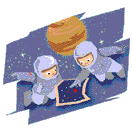
Reading Comprehension - Space AdventureA space adventure reading comprehension lesson. Reading passage combines science with reading in a fun, pretend story.
|
|
|
||
WRITING LESSON PLAN - MY FAVORITE THING |
||
|
Writing Lesson Plan - My Favorite ThingA writing lesson - students write about their favorite thing.
|
|
|
||
SAT VOCABULARY |
||
SAT Vocabulary Lesson and PracticeStudents study word meanings in order to expand their working usage of challenging vocabulary words similar to those found on the SAT college entrance exam. Includes synonyms, antonyms, and analogies. |
||
|
||
ADDITIONAL RESOURCES |
||
|
GrammarAlphabetHandwritingListening ComprehensionPhonicsProcess SkillsReadingSpeechSpellingVocabularyWriting |
|
|
||
|
||
|
||
For more teaching categories, including science, math, and history, please see the InstructorWeb home page. |
||
LANGUAGE ARTS LESSON PLANS ENGLISH WRITING READING WORKSHEETS GRAMMAR ELEMENTARY FREE TEACHING TOOLS TEACHER ONLINE CURRICULUM PRINTABLE RUBRICS EDUCATION SKILLS TERMS UNIT PLAN PROJECT PAGES ESL
Lessons recommended for teaching elementary education including kindergarten - first grade - second grade - third grade - fourth grade - fifth grade - sixth grade - seventh grade - preschool - special education. 1st Grade - 2nd Grade - 3rd Grade - 4th Grade - 5th Grade - 6th Grade - 7th Grade
Fun Mini Lesson Web Quests Terms - Adults Special Education - Teens - Teenagers - Kids - Children - Instruct - Theme - Thematic Unit - Children - Secondary Education - Middle School - Young Adults - Classroom - Test - Quiz - Review